Cargo theft is not simply a matter of a trailer disappearing from a parking lot. Today’s incidents can involve traditional theft, unauthorized trailer access, fraudulent pickups, impersonation of legitimate carriers and the redirection of freight already moving through the supply chain.
Recent data also shows why looking only at the number of reported thefts can be misleading. During the first nine months of 2026, reported incidents declined, but estimated financial losses increased substantially. For fleets, brokers, shippers and cargo owners, the challenge is increasingly about understanding what is happening around a shipment—not simply knowing where the vehicle is located.
Fewer Reported Incidents, but Higher Cargo Theft Losses
Verisk CargoNet reported 547 supply chain crime incidents across the United States and Canada during the third quarter of 2026. That represented a 33% decrease from the same quarter a year earlier.
The financial impact moved in the opposite direction. Estimated losses reached $230.1 million during the quarter. Through September 2026, estimated losses totaled $718.9 million—39% higher than during the same period in 2025.
Source: Verisk CargoNet, Q3 2026 cargo theft analysis , published November 4, 2026. CargoNet notes that prior-period figures can change as incidents are reported later.
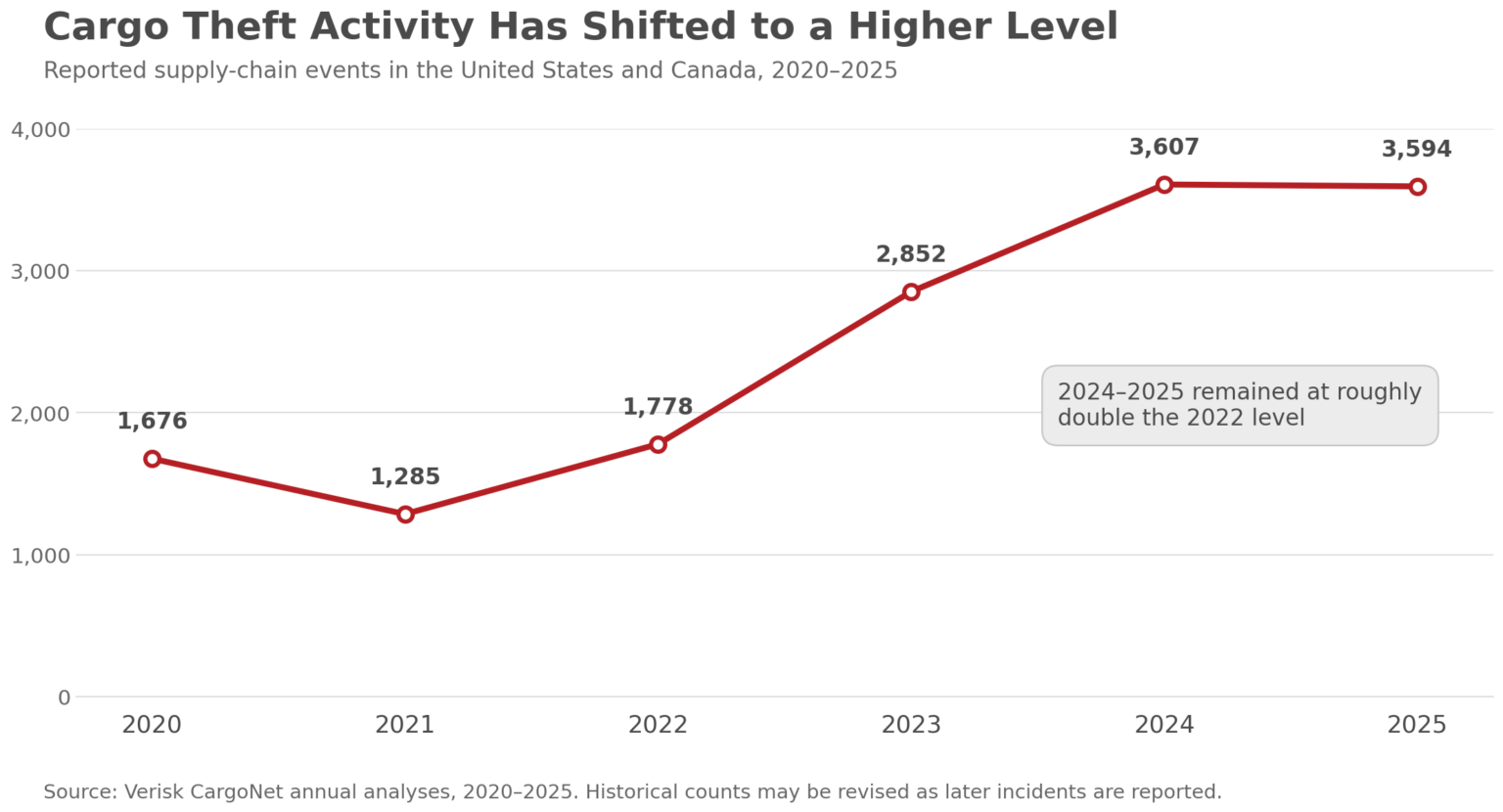
CargoNet also reported that the average value of stolen commodities among incidents with a documented value increased by approximately 72% year over year through September.
Cargo Theft Is Becoming More Than a Physical-Security Problem
Traditional theft remains a concern, but cargo crime increasingly includes deception and manipulation of normal transportation processes.
Fictitious pickups accounted for approximately one-quarter of reported CargoNet incidents during the third quarter of 2026. These schemes generally involve deception being used to obtain a shipment, such as impersonating a legitimate carrier or using false business or identity information.
CargoNet has also reported schemes involving compromised business email accounts, internet-based telephone systems and transportation-industry applications. Those methods can be used to obtain shipment information, impersonate legitimate companies or redirect freight.
That changes the cargo-security question. Organizations are no longer dealing only with:
- Was the truck or trailer stolen?
- Was a trailer door forced open?
- Did cargo disappear while a vehicle was parked?
They may also need to determine who arrived, which vehicle picked up the freight, what occurred during a handoff, whether unexpected personnel were present, and whether the physical activity around the shipment matched the transportation record.
Risk Is Concentrated Around Major Freight Networks
Cargo theft is not distributed evenly. In CargoNet’s Q3 2026 analysis, California, Illinois, New Jersey and Texas accounted for 57% of reported incidents.
County-level reporting also showed concentrations in Los Angeles, San Bernardino and Riverside counties in California, along with Harris County, Texas, and Cook County, Illinois.
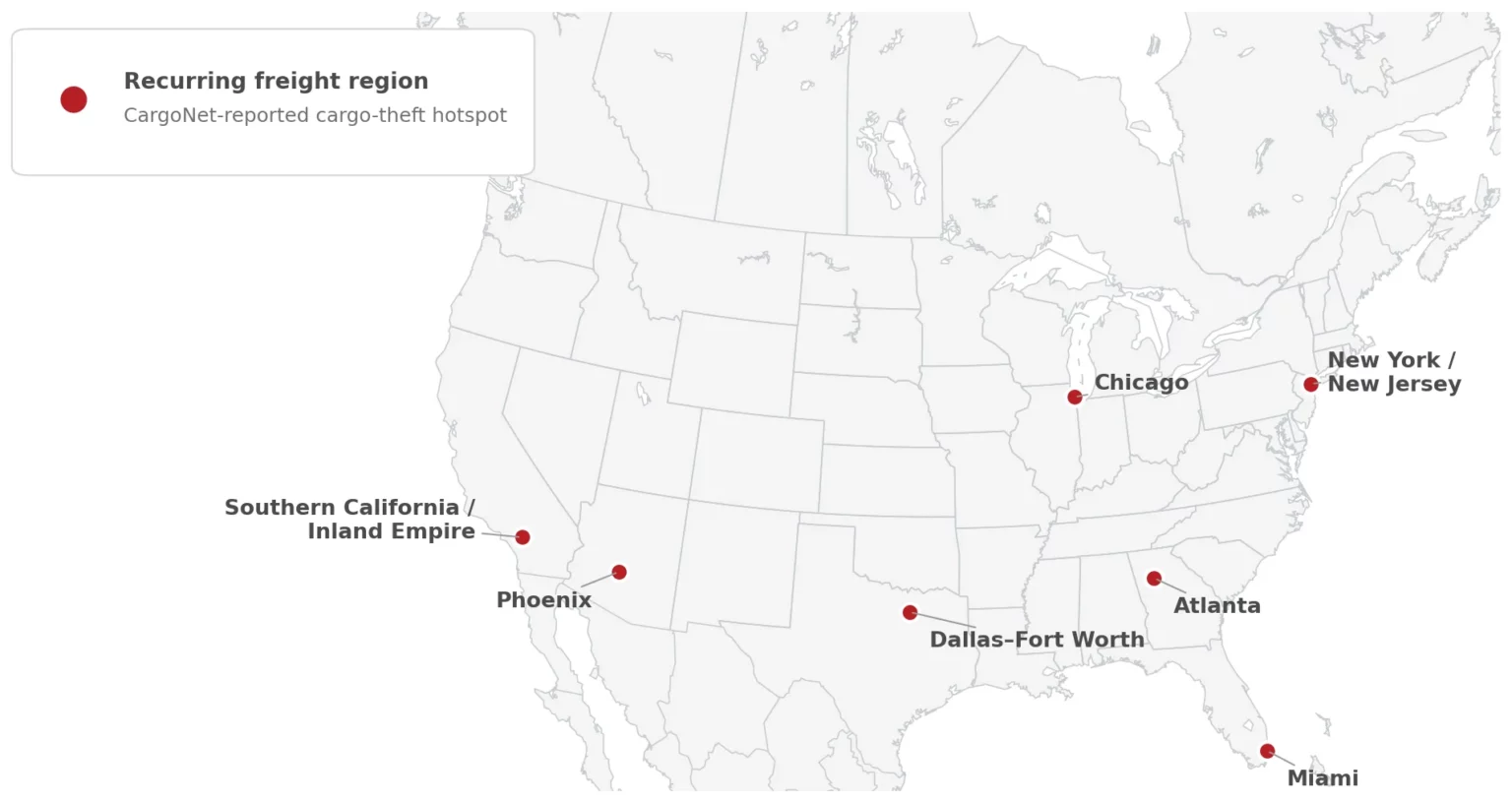
Major freight corridors, ports, distribution centers, warehouses, intermodal facilities and dense transportation networks create large volumes of cargo movement—and more opportunities for criminals to blend into legitimate commercial activity.
For companies operating through high-volume freight regions, cargo security extends beyond the point of origin and destination. Visibility is also important during staging, transfer, parking and other periods when freight remains stationary or changes hands.
Parked Freight Can Still Be Exposed Freight
Cargo does not become low risk simply because the vehicle has stopped moving.
Drivers may need to park at truck stops, rest areas, terminals, customer facilities, staging locations or other locations dictated by route timing and hours-of-service requirements. Trailers may also sit unattended while waiting for loading, unloading or the next stage of transportation.
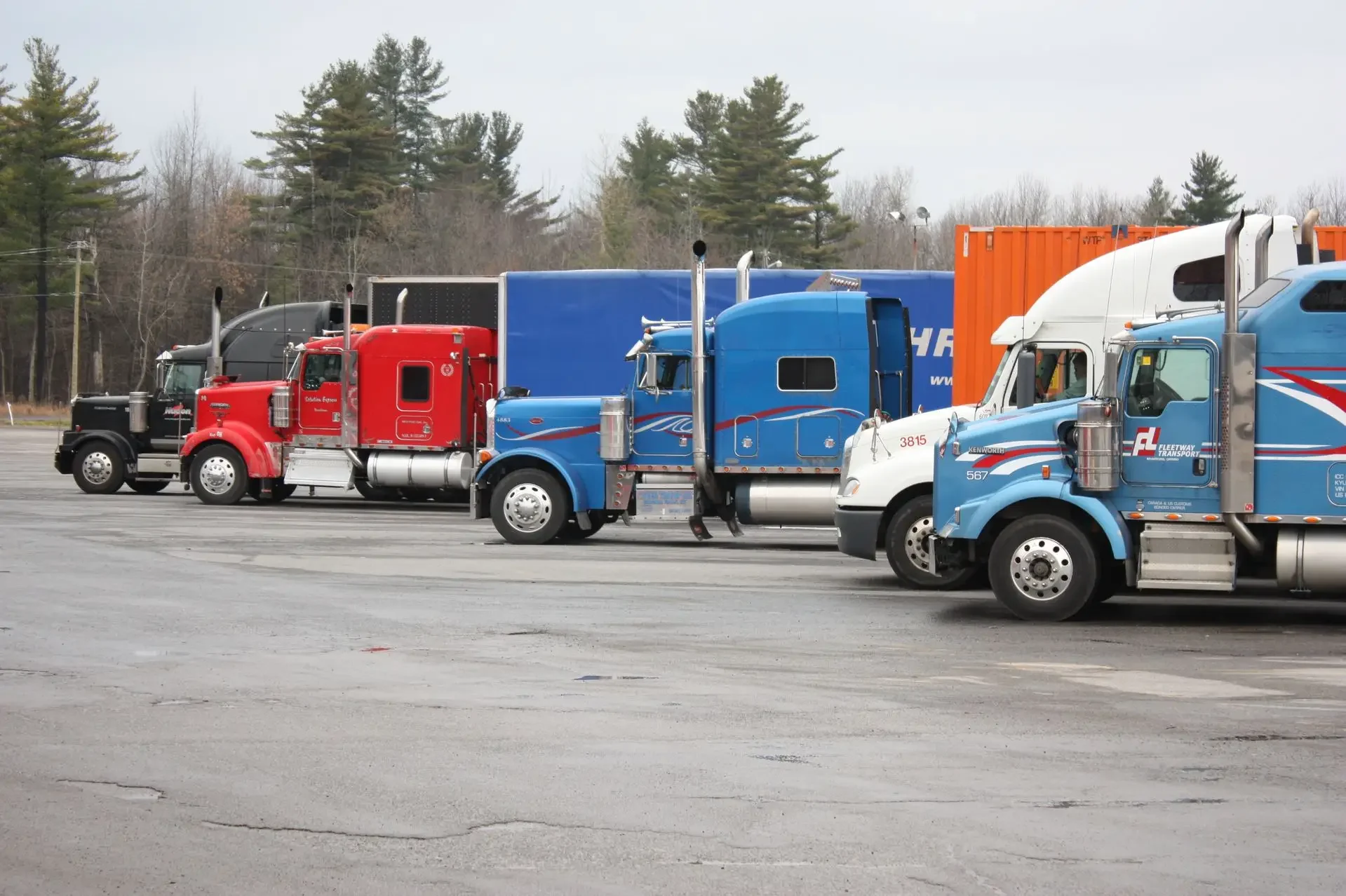
During those periods, GPS confirms where a vehicle or trailer is located. What GPS generally cannot show is what is physically happening around it.
Video provides another source of information around the commercial vehicle, trailer and cargo area—particularly when organizations need to understand activity that occurred while freight was parked or staged.
The Visibility Gap: Location Is Not the Same as Context
Cargo-security programs already use multiple tools. GPS and telematics provide location data. Bills of lading and transportation records document shipment movement. Locks and seals help protect physical access. Carrier and driver verification help reduce identity-related risk.
Each serves a different purpose.
Video adds something those systems cannot provide on their own: a visual record of activity around the vehicle and cargo.
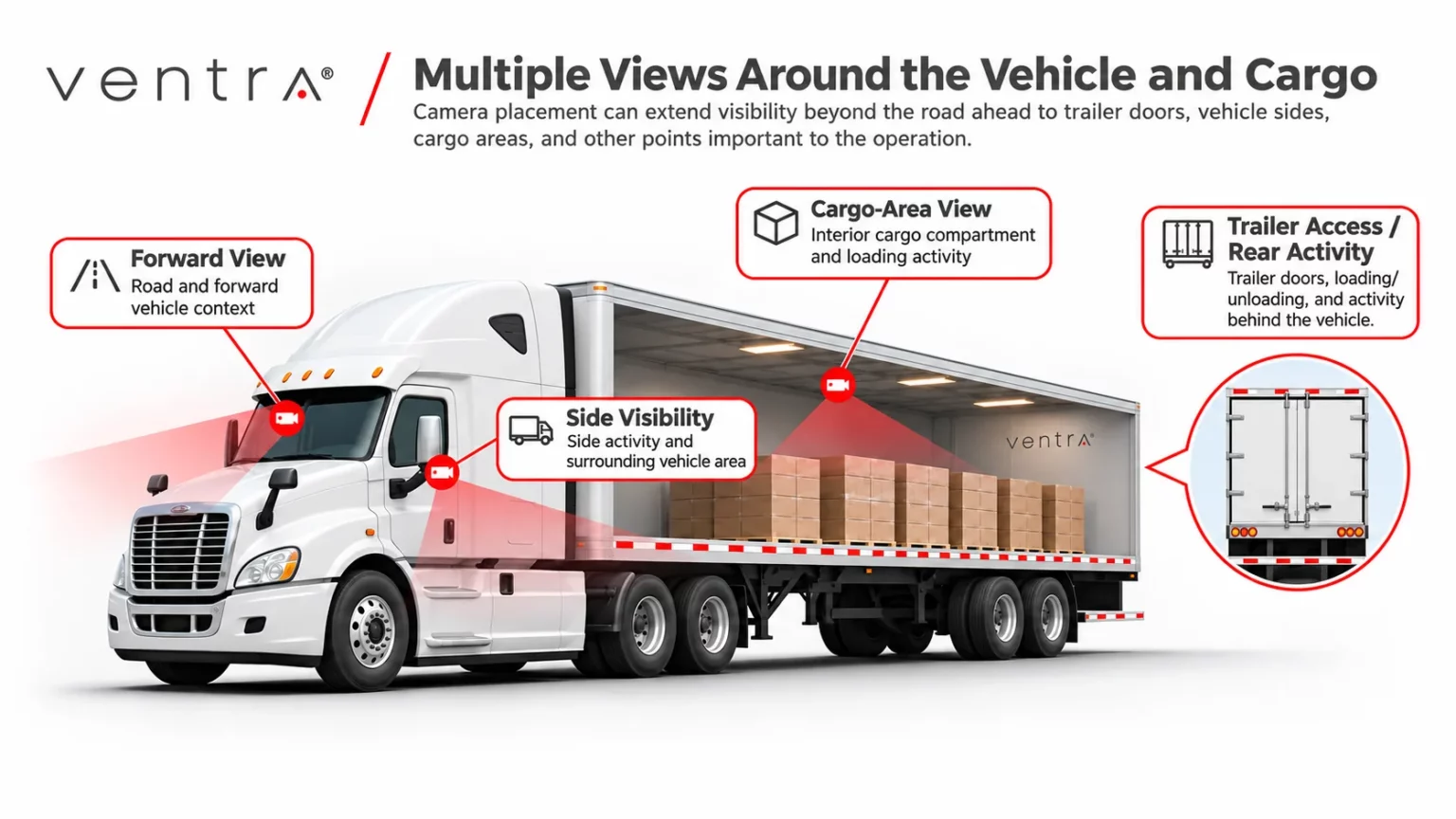
Depending on camera placement and system configuration, video helps organizations review:
- Loading and unloading activity
- Trailer-door and cargo-area access
- Activity around parked or staged vehicles
- Unexpected or unfamiliar personnel near the vehicle
- Vehicle movements and surrounding conditions
- What occurred before, during and after a reported incident
Video does not replace carrier vetting, locks, seals, GPS, secure operating procedures or communication across the supply chain.
Its value is in adding another layer of visibility and another source of evidence when something does not go according to plan.
Why Video Matters Before, During and After an Incident
Before an incident
Remote video access gives authorized personnel another way to check activity around a vehicle, trailer or cargo area. When combined with alerts, telematics and established operating procedures, it helps teams investigate unusual activity rather than relying only on a location point on a map.
During an event
Cameras provide visual information about activity occurring around the vehicle. Depending on camera placement and system configuration, that includes trailer access, people approaching the cargo area and activity during loading, unloading and staging.
After an incident
Recorded footage helps establish a timeline and provides additional context for internal reviews, insurance claims and investigations. Instead of relying entirely on recollection or location history, organizations have another visual record showing what occurred around the asset.
Cargo Security Works Best as a Layered Approach
There is no single technology that eliminates cargo theft. Treating any one tool as a complete solution creates another vulnerability.
A stronger approach combines complementary controls.
Procedures and communication matter just as much as technology. When a shipment, driver, carrier, destination or pickup instruction changes unexpectedly, the ability to verify that change is critical.
Learn more about how Ventra Cargo Visibility & Security adds video visibility around commercial vehicles, trailers and cargo areas.
Cargo Visibility Extends Beyond Long-Haul Trucking
The same visibility challenge appears throughout the movement of goods.
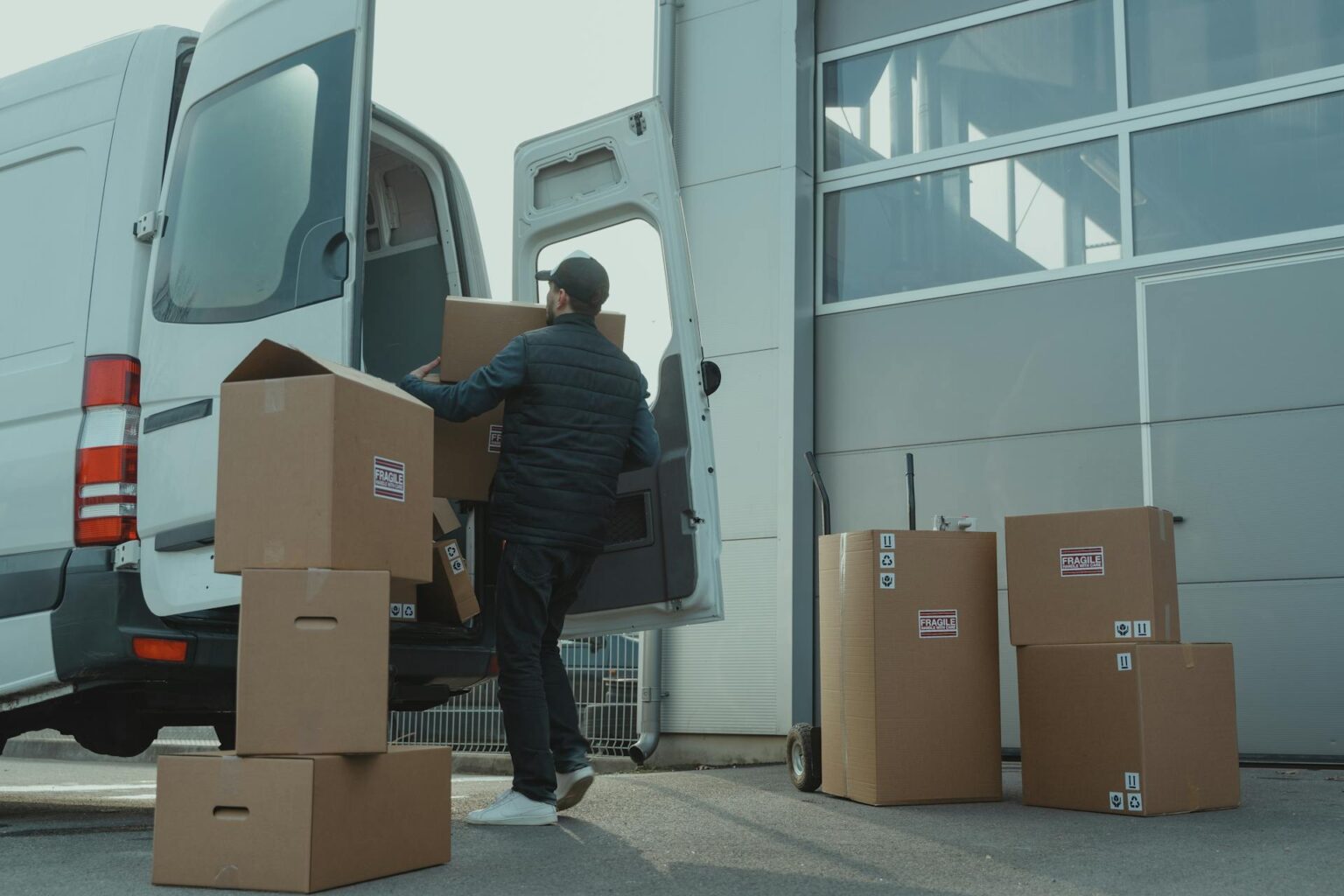
Commercial trucks and trailers are an obvious application, but cargo also moves through delivery vans, box trucks, rail and intermodal operations, terminals, distribution centers and transfer points.
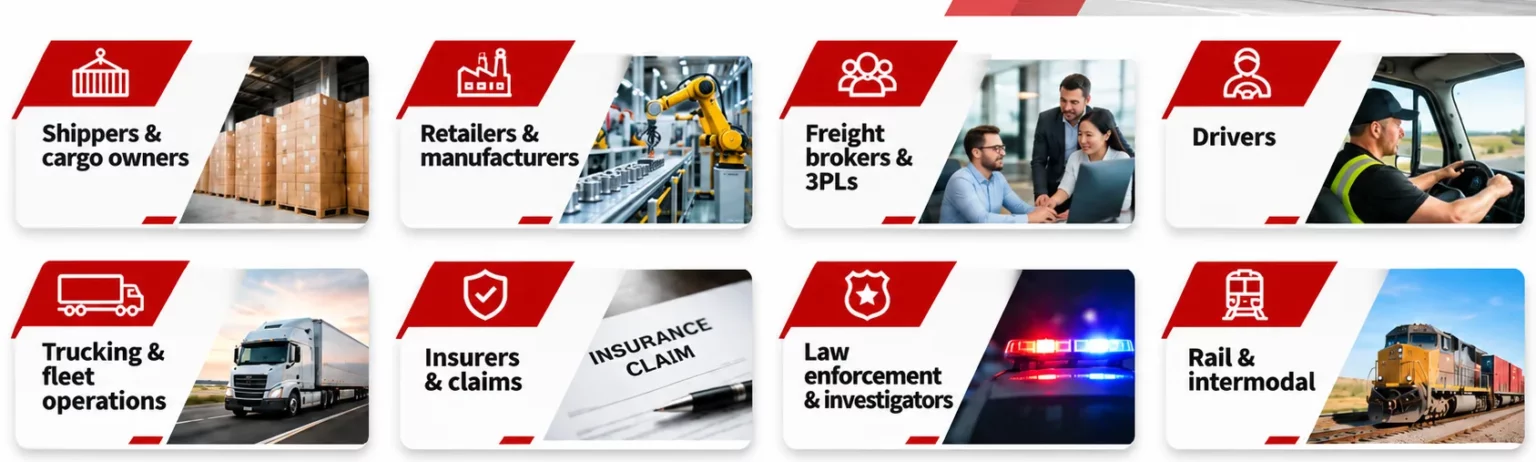
Every handoff creates another point where the information in a transportation system needs to match what is happening in the physical world.
For shippers and cargo owners, that means better documentation of how goods move through the transportation process. For fleets and drivers, it adds visibility around the vehicle. For brokers, insurers and investigators, recorded video provides another source of information when reconstructing an incident.
What to Watch Going Into 2027
The exact cargo-theft picture for 2027 will depend on economic conditions, commodity demand, enforcement activity and how criminal groups adapt. But several patterns visible in 2026 are worth watching.
Cargo theft appears to be becoming more selective as well as more sophisticated. Even while reported incident counts declined during parts of 2026, losses increased as organized groups targeted higher-value freight. At the same time, fictitious pickups, business email compromise, shipment misdirection and other identity-based schemes remained persistent.
That suggests the cargo-security challenge going into 2027 is unlikely to be limited to preventing physical theft. Organizations may need to pay increasing attention to the combination of identity verification, shipment visibility, communication security and physical monitoring around vehicles, trailers and cargo.
Major freight hubs, high-value commodities, unattended or staged freight and periods of reduced staffing are also likely to remain important areas of exposure. The practical takeaway is not to predict exactly where the next incident will occur, but to make sure there are enough independent layers of information to recognize unusual activity and reconstruct what happened if something goes wrong.
What the 2026 Data Should Change
The key lesson from current cargo-theft data is not simply that companies need more security equipment.
The more useful lesson is that cargo risk is changing.
Criminals target high-value commodities, exploit transportation handoffs and combine traditional theft with digital deception. At the same time, a shipment may pass through multiple organizations, drivers, facilities and parking locations before reaching its destination.
That makes visibility increasingly important.
Organizations should know not only where valuable freight is supposed to be, but also what information they will have available if something unexpected occurs.
Location data answers one part of that question. Documentation, access controls and verification procedures answer others. Video adds visual context that those systems do not provide on their own.
See How Video Adds Another Layer of Cargo Visibility
Ventra video solutions add visibility around commercial vehicles, trailers and cargo areas—during transportation, while parked or staged, and when an incident needs to be reviewed.
EXPLORE CARGO VISIBILITY & SECURITYVerisk CargoNet, “Fewer Cargo Thefts, Bigger Losses: Average Theft Value Jumps 72 Percent Year to Date” , November 4, 2026.
Figures cited in this article are based on reported cargo and supply-chain crime incidents. CargoNet notes that historical figures can change as additional incidents are reported.